
On Private Collections as Public Memory Infrastructure
Public Memory Nodes — A Clearance Archive Series

A drawer of discontinued nail polish, each bottle slightly thickened with age.
A shoebox of enamel pins from political campaigns that no longer exist.
A plastic bin of burned mix CDs, labeled in careful handwriting: Summer ’02, Driving West, Happy Birthday.
These objects were not produced for longevity. They were seasonal, promotional, mass-manufactured, culturally momentary. Many were engineered for rapid obsolescence.
They remain because someone kept them.
Private collections are rarely framed as civic acts. More often they are categorized as clutter, nostalgia, excess. Yet a collection — even one assembled without institutional intention — performs a function associated with formal archives: preservation, classification, continuity.
A private collection is a decentralized archive maintained without mandate, funding, or recognition.
Public Memory Nodes designates such collections as sites where personal preservation intersects with collective cultural record. 1

Accumulation as Maintenance
Contemporary consumer culture organizes itself around circulation and replacement. Accumulation is frequently positioned as dysfunction within this system. Preservation operates differently.
To preserve is to suspend disposal. It extends the lifespan of objects designed for short-term relevance. A collection holds material in temporal friction, separating it from market timelines and redirecting it into duration.
This is maintenance.
Not maintenance of function alone, but maintenance of continuity — of memory, evidence, context.
Private collectors stabilize fragments of unstable production. In environments structured by acceleration, the act of keeping generates resistance through duration.2

Public Memory Nodes proceeds from this condition: accumulation, examined closely, operates as decentralized maintenance practice.
AI as Synthesis Tool
A single object can be researched and contextualized. A collection produces pattern.
Pattern exceeds individual memory.
Across hundreds of political buttons, election rhetoric and graphic language shift visibly. Across mall postcards, architectural cycles emerge. Across identical fast-fashion heels, aspiration materializes as repetition. Private fashion archives — such as significant collections of Comme des Garçons garments assembled by individual collectors and later exhibited or auctioned — demonstrate how serial accumulation transforms clothing into historical record.3
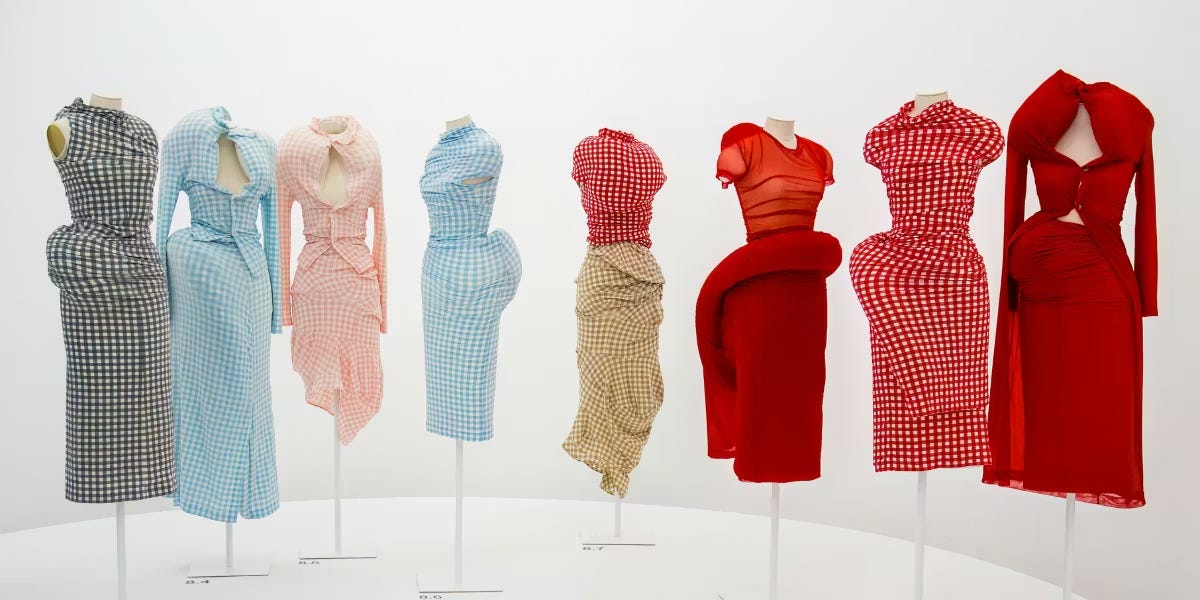
AI enables synthesis at the scale of aggregated material culture. It processes temporal clustering, geographic distribution, linguistic recurrence, production shifts, and digital discourse across public-domain data. It assembles macro-fields of association that would otherwise remain diffuse.
The collector embodies lived accumulation.
AI processes structural pattern.
The custodian situates these patterns within cultural systems to articulate meaning as collective memory.
This triangulation forms the methodology of Public Memory Nodes.
AI operates as archival instrument. Its role is suitability: synthesizing scale while leaving interpretation within human relational context.
Collapse-Era Consumer Culture as Anthropological Material
Many objects within these collections were not intended to endure. Their material quality reflects disposability. Their relevance was designed to expire.
Aggregated over time, they form record.
They trace cycles of desire and aspiration.
They register branding as ideological infrastructure.
They map rhetorical shifts and manufacturing economies.
They reveal aesthetic standardization and narratives of identity produced at scale.
They index materiality itself as expression of consumer value.
In isolation, these objects appear trivial. In aggregate, they function as fossil record.
Public Memory Nodes approaches mass-produced objects as anthropological artifacts of a specific economic and cultural condition. Disposable culture becomes evidentiary material.4

From Private Preservation to Public Memory
Documentation transforms preservation into infrastructure.
Each Node includes:
A collector statement outlining origin and accumulation logic.
AI-assisted synthesis of pattern and historical field.
Custodial interpretation situating the collection within broader cultural systems.
Visual documentation and indexing.
Through this structure, the collection remains privately held while entering the public domain as knowledge. Interpretive infrastructure attaches to the material without displacing it.
In certain instances, individual objects may re-enter circulation. When they do, they carry their Node designation and contextual record. Stewardship transfers extend the network of preservation rather than dissolving it.
Memory travels with the object.
Decentralization and the Public Domain
Private collections already function as decentralized archives. Their documentation benefits from storage systems aligned with durability rather than platform volatility. Distributed access supports the public domain as shared cultural infrastructure.
The archive should outlive the interface.
Public Memory Nodes locates memory across drawers, shelves, storage bins, and shoeboxes — wherever material is withheld from obsolescence. Through synthesis and custodial interpretation, decentralized collections become legible as shared record.
Garbage is designation.
Debris becomes archive through attention.
Public Memory Nodes concentrates fragments of consumer culture into nodes of collective memory — distributed points within a network of shared experience.
Afterword: On Continuity and Phase
Public Memory Nodes extends prior work developed through Sacred Protocol and the ongoing custodial practice of Clearance Archive.
Sacred Protocol examined AI as a site of deliberate inquiry — a system through which collective knowledge could be approached with intention rather than acceleration. Clearance Archive has functioned as a maintenance practice: restoring, recontextualizing, and recirculating material culture through acts of care and documentation.
Public Memory Nodes formalizes the convergence of these trajectories. It situates AI as archival instrument within a field of material preservation and extends maintenance beyond individual objects into aggregated collections. Where Sacred Protocol explored systems of collective meaning, and Clearance Archive examined the afterlives of objects, Public Memory Nodes addresses the structural threshold between them: private preservation as distributed cultural infrastructure.
This essay establishes the framework. What follows constitutes its second phase — proof through material study.
Initial expressions will take the form of independently published zines documenting individual Nodes through collector statement, AI synthesis, custodial interpretation, and indexed visual record. Further iterations may expand into physical installations, distributed archival storage, and participatory collection studies.
The infrastructure is defined.
The Nodes will accumulate.
References / Visual Footnotes
Rivera, Greg. “World’s Largest Mr. T Doll Collection.” Ripley’s Believe It or Not.
https://www.ripleys.com/stories/mr-t-doll-collector
Vogel, Dorothy and Herbert. Installation view of private collection, New York apartment. c. 1970s–1980s. National Gallery of Art Archives.
https://oddathenaeum.com/the-art-collection-of-dorothy-herbert-vogel/
Vogue. “Comme des Garçons Private Collection Auction.”
https://www.vogue.com/article/comme-des-garcons-auction-paris
Clearance Archive. “Blowout Badge.” Digital archive entry, Clearance Archive.
https://www.clearancearchive.com/archive/p/blowout-badge