
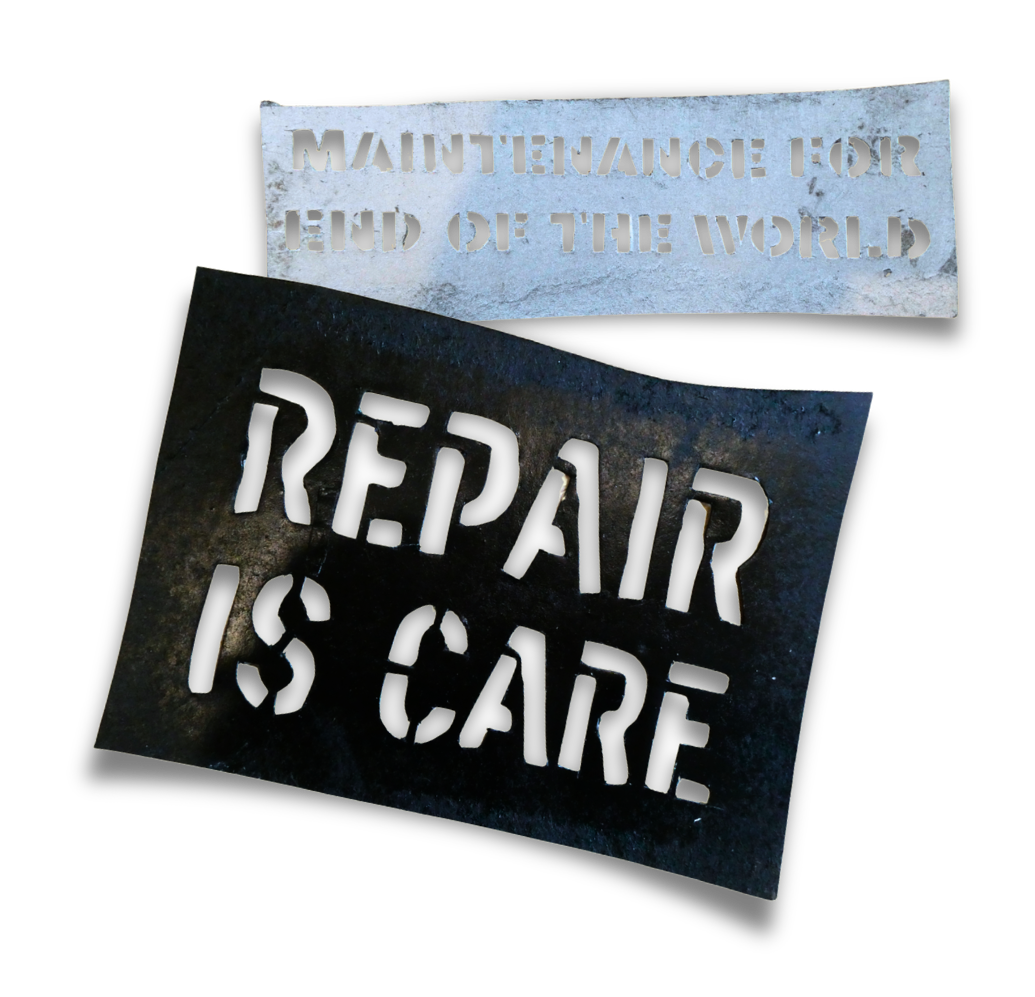
Repair is Care
Maintenance for the End of the World

I am an artist working in public space, operating a small folding repair stand throughout the summer.
The structure is simple: a wooden frame that opens into a temporary workstation, holding a hand-quilted sign, a set of sewing tools, and a selection of handmade patches available for purchase. Alongside this, I offer hand-sewn repairs—buttons, tears, reinforcement—on a pay-what-you-like basis.
Locations are shared in advance at clearancearchive.com and @clearance.archive
This work forms part of an ongoing maintenance art practice.1
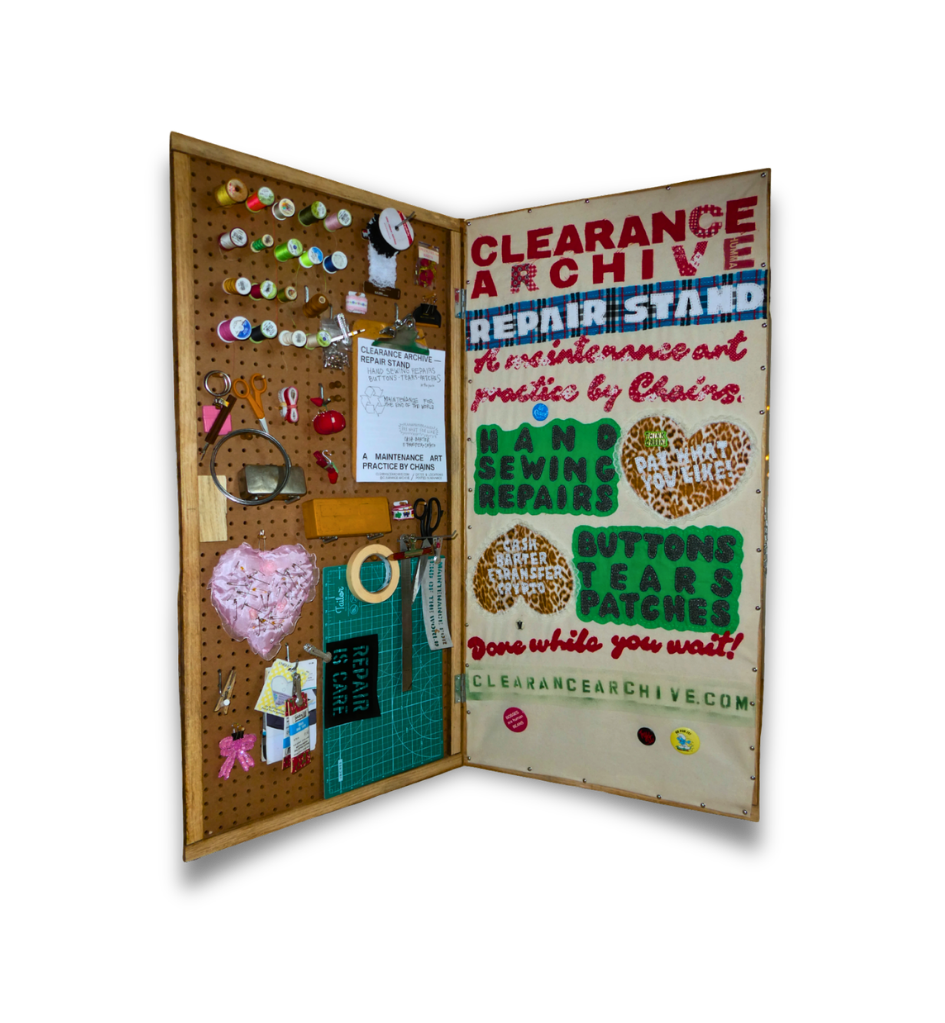
The repair stand appears first as a simple structure, but it operates within a broader framework.
Garments are brought forward in varying states of wear—split seams, missing buttons, fabric worn thin at points of friction. The work proceeds in the open, often in conversation, sometimes in silence. The repair is completed while the owner waits, or it is left and returned to.
This activity is straightforward in its function, but it is situated within a larger inquiry.
The Clearance Archive Repair Stand positions repair not as an auxiliary service, but as a primary cultural act—one concerned with the continuation of objects, the conditions of their use, and the relationships that form around them.2
To repair an object is to intervene in its trajectory. It extends its life, but more importantly, it affirms that the object remains in circulation—materially and socially.3 The decision to repair is therefore not only practical, but evaluative. It asks what is worth maintaining, and under what conditions.
Under contemporary economic systems, value is disproportionately assigned to production: to what is new, scalable, and capable of growth. Maintenance, by contrast, operates through repetition, attention, and constraint. It does not produce novelty. It sustains what already exists. As a result, it is frequently rendered invisible or secondary, despite its structural necessity.4
This project builds on the foundation established by Mierle Laderman Ukeles, whose articulation of maintenance art brought visibility to forms of labor historically excluded from cultural recognition.5 Cleaning, caring, repairing, and sustaining were framed not as background activities, but as essential practices that reveal how systems are upheld.
The conditions in which maintenance now operates, however, differ significantly from those in which that work emerged. Institutional stability can no longer be assumed. Public infrastructure is uneven, and social life is increasingly shaped by precarity and exhaustion. Maintenance no longer functions primarily as critique within stable systems; it is embedded within the conditions of their instability.6
In this context, maintenance becomes a way of working through constraint rather than escaping it. It engages directly with what is present—existing materials, existing systems, existing limits—and asks how they can be held, adjusted, or continued.
My own relationship to this work is shaped by a movement through other forms of labor. A background in commercial creative direction, structured around acceleration, output, and continuous production, produced both familiarity and eventual incompatibility. The terms of that work—efficiency, optimization, growth—do not translate easily into a practice centered on repair.7
What emerges instead is a different orientation toward labor. One that is slower, materially grounded, and attentive to limits.
This shift also intersects with a reconsideration of forms of labor historically coded as feminine: domestic work, care work, maintenance. These are not treated here as inherited roles or obligations, but as sites of knowledge and capability.8 Skills developed through repetition, attention, and care become relevant again under conditions where durability and continuity matter more than expansion.
The repair stand makes these dynamics visible in a localized and immediate way. Each repair is specific. Each object arrives with its own history of use, its own material constraints, and its own significance to its owner. The work required is rarely standardized. It involves assessment, adaptation, and a degree of improvisation.9
At the same time, these individual repairs accumulate into a larger body of material.
Through documentation—written repair slips, photographs, and recorded observations—these interactions can be gathered into an evolving archive. This archive does not function as a static repository, but as a record of use, care, and decision-making over time. It reflects not only objects, but relationships: between people and their belongings, between labor and value, between continuation and discard.10
The question of tools becomes central within this framework.
The work begins with simple, established instruments: needle, thread, hand. These tools are direct, legible, and sufficient for many forms of repair. At the same time, contemporary tools—particularly those related to computation and artificial intelligence—offer different forms of support. They enable the organization, indexing, and interpretation of accumulated material in ways that extend beyond what manual systems can sustain alone.11
The integration of these tools is approached deliberately. They are not used to replace the labor of repair, nor to accelerate it unnecessarily, but to support continuity, reflection, and access. The aim is not efficiency in the conventional sense, but coherence over time.
The guiding question becomes practical rather than ideological: what tool, in a given situation, allows the work to be carried forward effectively?12
Within this approach, older and newer tools are not positioned in opposition. They are evaluated in relation to the task at hand.
The repair stand therefore operates across multiple scales simultaneously. At one level, it provides an immediate, tangible function: garments are repaired and returned to use. At another, it functions as a site of observation and documentation. At a broader level, it contributes to an ongoing inquiry into how value is assigned, how labor is organized, and how material culture persists.
Clearance Archive as a whole reflects this structure. It exists both as a store and as an archive, participating in systems of exchange while also examining them. It treats objects not as isolated commodities, but as part of a larger network of relationships, histories, and uses.13
The repair stand extends this logic into the public domain. It introduces a small, accessible infrastructure through which maintenance can be practiced, observed, and reconsidered.
What emerges is not a solution, but a set of working conditions.
A way of proceeding with what is already here.
Mierle Laderman Ukeles, Manifesto for Maintenance Art, 1969.
Stephen J. Jackson, “Rethinking Repair,” in Media Technologies: Essays on Communication, Materiality, and Society, MIT Press, 2014.
Glenn Adamson, Fewer, Better Things: The Hidden Wisdom of Objects, Bloomsbury, 2018.
Nancy Fraser, “Contradictions of Capital and Care,” New Left Review, 2016.
Mierle Laderman Ukeles, Manifesto for Maintenance Art, 1969.
Mark Fisher, Capitalist Realism: Is There No Alternative?, Zero Books, 2009.
David Graeber, Bullshit Jobs: A Theory, Simon & Schuster, 2018.
Silvia Federici, Caliban and the Witch, Autonomedia, 2004.
Richard Sennett, The Craftsman, Yale University Press, 2008.
Susan Leigh Star & Karen Ruhleder, “Steps Toward an Ecology of Infrastructure,” 1996.
Yuk Hui, The Question Concerning Technology in China, Urbanomic, 2016.
Donna Haraway, “A Cyborg Manifesto,” 1985.
Arjun Appadurai, The Social Life of Things, Cambridge University Press, 1986.